
Radiologic Technology
Associate of Applied Science (AAS)
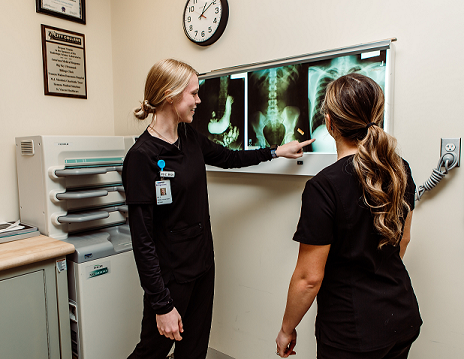
If you are searching for an in-demand career in the medical field that combines science, technology and human interaction, Radiologic Technology may be the field for you. Radiologic Technologists (Rad Techs) act as a vital member of the healthcare team in a variety of clinical settings. As a Rad Tech, you will prepare patients for, and administer, X-rays and other radiological medical procedures. At City College, you will experience a high-tech education in a modern lab setting, with plenty of hands-on experience applying principals of radiation exposure, physics, biology and safety to produce medical diagnostic images. You will also get real-world experience doing your clinical rotations in health care settings around the area.
The mission of the Radiologic Technology Program at City College at MSUB is to provide a comprehensive didactic and clinical education that will produce quality entry-level radiologic technologists to meet the needs of the students, community, state, and nation. Upon completion of this program students will earn an Associate of Applied Science Degree in Radiologic Technology and be eligible to become certified by taking the registry examination of the American Registry of Radiologic Technologist (ARRT), and apply for state licensures where applicable. This program is accredited by the Joint Review Committee on Education in Radiologic Technology (JRCERT). Inquiries regarding the JRCERT accreditation can be made by contacting JRCERT at 20 North Wacker Drive, Suite 2850, Chicago IL 60606-3182 or (312) 704-5300 or mail@jrcert.org.
Prior to applying for the Radiologic Technology program, students must be admitted to City College, and have completed the necessary prerequisites. We currently take in between 12 to 14 students once per year, pending clinical space availablity.
| TERM | DEADLINE | APPLICATION | STATUS |
| Fall 2026 | May 27, 2026 | closed - not accepting apps | |
| Fall 2027 | May 2027 | not accepting apps yet |
| KEY | |
| Accepting applications for this semester | |
| Not yet accepting applications for this semester | |
| Application closed for this semester | |
Cost of Attendance
City College - Associate Degrees & Certificates
Transportation Costs
Students are responsible for all geographically dispersed transportation and associated costs to and from City College at MSU Billings for didactic and laboratory classes, and for their off-site assigned clinical hours for the duration of the program.
Radiologic Technologist
| Median Wage (MT)* | $75,280 yearly |
| $36.19 per hour | |
|
|
|
| Median Wage (US)* | $77,660 yearly |
|
$37.34 per hour |
|
City College entry-level wages of graduates:$56,611 (2021-2024) |
|
|
|
|
| Expected growth (MT)* | 15% |
| Expected growth (US)* | 6% |
|
*Bureau of Labor Statistics, Office of Employment Projections; MT Dept. of Labor and Industry, Research and Analysis Bureau; (projections through 2024) |
|
As a Radiologic Technologist, you will find employment in a variety of settings, such as:
- Hospital Radiology Departments
- Clinics’ Radiology Departments
- Physicians’ Offices
- Surgical Centers
- Other Specialized Medical Facilities
Examples of where recent City College graduates are working:
- Billings Clinic, Billings, MT
- St. Vincent Healthcare, Billings, MT
- Advanced Care Hospital, Billings, MT
- Stillwater Billings Clinic, Columbus, MT
- Hardin Clinic, Hardin, MT
- Legacy Health, Portland, OR
- Yujib-Kuskokwin Health Corporation, Bethel, AK
ADMISSION TO CITY COLLEGE
- First-time college students must have high school diplomas from an accredited high school, a GED/HiSET, or passed the MSUB Readiness Exam offered through our university.
- Transfer students will need to submit records from all regionally accredited institutions.
ADMISSION TO RADIOLOGIC TECHNOLOGY PROGRAM
After applying to City College and completing the necessary prerequisite courses, students may apply to the Radiologic Technology program. Due to limited clinical/laboratory space, only 12-14 students per year will be selected to continue in the clinical part of the program

The Radiography Program is accredited by the
Joint Review Committee on Education in Radiologic Technology (JRCERT)
20 N. Wacker Drive, Suite 2850
Chicago, IL 60606-3182
312-704-5300
Email mail@jrcert.org
The program’s current award is 8 years. General program accreditation information and the current accreditation award letter can be found on the JRCERT website: https://www.jrcert.org/programs/montana-state-university-billings/
Montana State University Billings is accredited by the Northwest Commission of Colleges and Universities (NWCCU).
Upon completion of this program, students are eligible to take the American Registry of Radiologic Technologists (ARRT) certification exam.
Radiologic Technology » »
Thematic Concentration in Radiologic Technology Management
Students who earn an AAS degree and want to further their education, and thus career, are able to go on for a Bachelor of Applied Science (BAS) Degree through MSU Billings. Students can focus on various thematic concentrations to earn the BAS degree, but one option is Radiologic Technology Management. Contact Advising & Career Services at 406-657-2240 for further details. Please see an Academic Advisor for more information.
- Includes information on program goals, mission, educational outcomes, JRCERT,grading system, attendance, grading, probation, progression, termination/dismissal, academic due process and grievance policies/procedures
Clinical Obligations
Collectively the clinical affiliates provide a sufficient number and variety of radiographicprocedures
to offer students a well-balanced, supervised clinical experience. Students are scheduled
for 8-hour shifts in various clinical rotations, generally from 5:00 am to 4:30 pm(varies).
A portion of the clinical experience will also include additional rotations during
weekend day shifts and weeknight shifts (2:30 pm to 11:00 pm). The entire semester
clinical schedule will be provided before the beginning of each semester. Clinical
sites are located up to 40 miles from the City College campus. Transportation to and
from these sites is the student’s responsibility. Program faculty will not make exceptions
or
adjustments in clinical assignments based upon traveling distance. Clinical attendance
is mandatory.
Note: Vaccinations, a cleared criminal background check and clean drug screen are required for all clinical sites on an annual basis. Specifics on fees and clinical onboarding procedures are discussed at the mandatory welcome meeting, once admitted to the program.
In the second year, students have opportunities to rotate into other modalities (for
observation only) such as CT, MRI, Radiation Therapy and Mammography. These
observations are scheduled for one week rotation per semester.
All clinical sites are affiliated with City College by contract and are approved by
the program’s accreditation the JRCERT. They make the ultimate decision if a student
is approved to rotate to their site. If a student is not cleared or permitted to attend
one clinical site, for any reason, then the student will not progress in the program.
Reasons for not being approved to attend a site(s) may include criminal background,
drug screen, not meeting vaccination requirements, and any other reason deemed as
such by the site.
Clinical education centers and locations (links below include directions):
- Big Horn Hospital (Critical Access Hospital), Hardin, MT
- Billings Clinic (including clinic, hospital, ortho, and Surgery Center rotations),
Billings, MT - Intermountain Health Broadwater Clinic, Billings, MT
- Intermountain Health (St. Vincent’s-including clinic, hospital, and ortho rotations), Billings, MT
- Roundup Memorial (Critical Access Hospital, Roundup, MT
- Other clinical sites may be used as necessary
The program’s policy regarding student clinical rotations in mammography (may be applied to any imaging procedures performed by professionals who are of the opposite gender of the patient) is based on the sound rationale presented in a position statement on student clinical mammography rotations adopted by the Board of Directors of the Joint Review Committee on Education in Radiologic Technology (JRCERT) at its April 2016 meeting. The JRCERT position statement is available on the JRCERT Web site, www.jrcert.org, Programs & Faculty, Program Resources.
MSUB Radiography Program Policy: All students, male and female, will be offered the opportunity to participate in clinical mammography rotations. The program will make every effort to place a male student in a clinical mammography rotation if requested; however, the program cannot override clinical setting policies that restrict clinical experiences in mammography to female students. Male students are advised that placement in a mammography rotation is not guaranteed and is subject to the availability of a clinical setting that allows males to participate in mammographic imaging procedures. The program will not deny female students the opportunity to participate in mammography rotations if clinical settings are not available to provide the same opportunity to male students.